What is driving the current wave of India's voter protests?
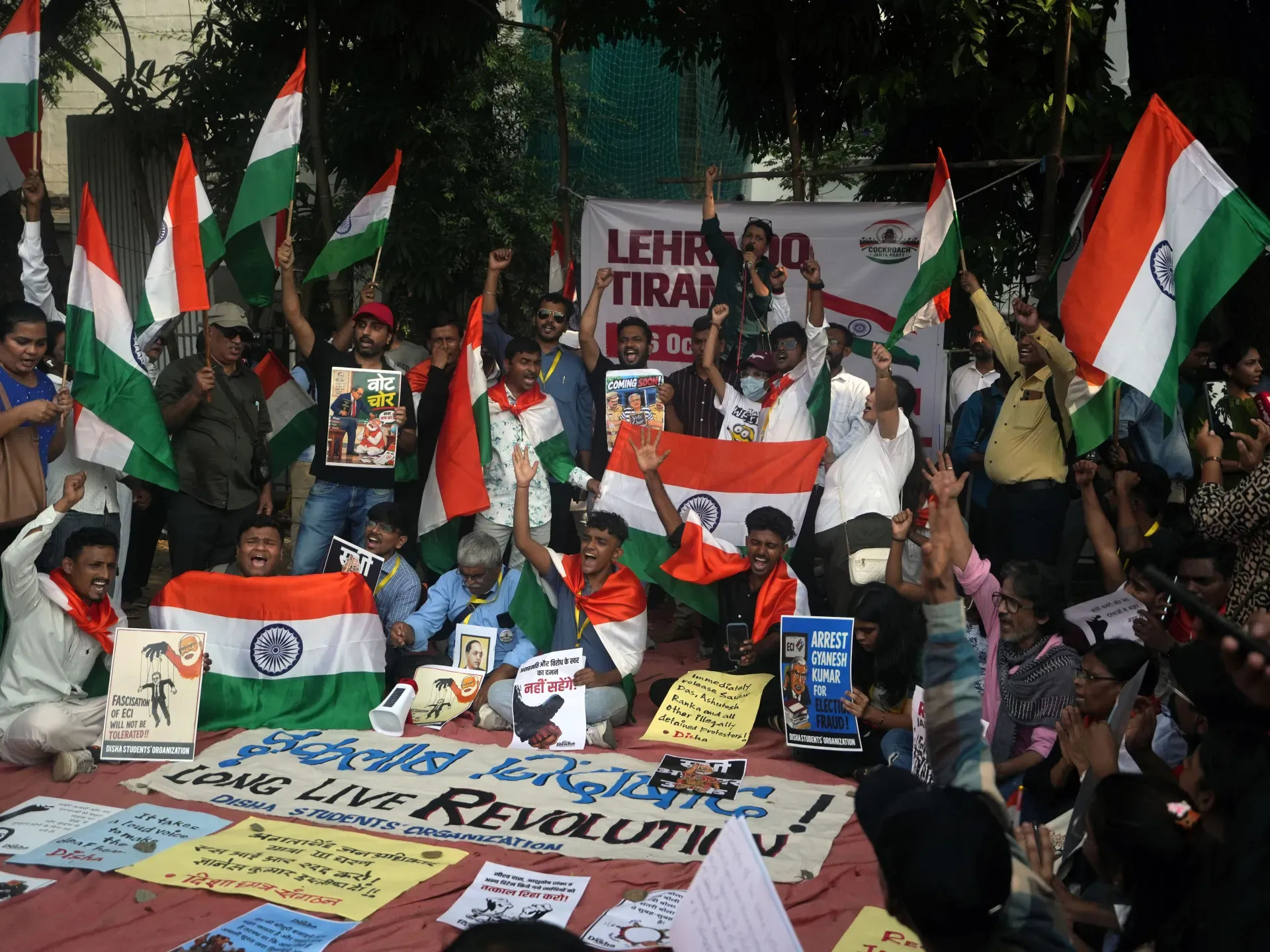
The primary driver of the current unrest is the Special Intensive Revision (SIR) conducted by the Election Commission of India (ECI), which has resulted in the removal of an estimated 130 million names from voter lists. Protesters, including students, farmers, and opposition parties, are demanding the resignation of Chief Election Commissioner (CEC) Gyanesh Kumar and the reinstatement of previous electoral rolls. The SIR process mandates that citizens provide specific historical documents to verify their eligibility to vote.
This administrative exercise has sparked widespread fear because it mirrors the concerns raised by Muslim communities six years ago. At that time, activists warned that making citizenship contingent on rigid documentation requirements could lead to mass disenfranchisement. Now that the scale of exclusion has expanded to include various other demographics, the scale of the protests has grown, even as the underlying legal tensions remain unresolved.
How does the Special Intensive Revision function in practice?
The SIR operates by requiring voters to substantiate their identity and citizenship through specific document thresholds, often based on birth dates. According to the ECI's implementation in Bihar starting in June 2025, the complexity of required documentation increases for younger generations. Specifically, the rules hinge on two key dates: July 1, 1987, and December 2, 2004. Those born after the later date are required to produce a higher volume of parental documentation to secure their place on the rolls.
The ECI has defended these measures in the Supreme Court, stating that the revision is intended to verify citizenship in accordance with the 2003 amendment. However, critics argue that this effectively transforms the voter list into a tool for citizenship verification, bypassing the need for a formal National Register of Citizens (NRC) announcement. The stated goal of the revision, as articulated by Home Minister Amit Shah in Parliament last December, is to "detect, delete and deport infiltrators.'
The distinction between refugees and infiltrators
The current administrative framework relies on a legal distinction between refugees and infiltrators based on their motivation for entering the country. Under the logic of the Citizenship Amendment Act (CAA), individuals seeking safety based on religious persecution are classified as refugees, whereas those moving for economic reasons are labeled as infiltrators. This distinction is central to how the SIR identifies individuals for removal from the electoral rolls.
What was the impact of the revision in West Bengal?
In West Bengal, the electoral revision has already reached completion, providing a clear view of the potential consequences of the SIR. Approximately 9.1 million names—representing about 12 percent of the state's electorate—were removed prior to the April elections. While initial stages of removal appeared proportional to population demographics, the subsequent stages of the process showed significant disparities.
The removal process occurred in two distinct phases:
- Phase 1: Administrative marking. Voters were marked as absent, deceased, or duplicates. During this stage, the removal of Hindus and Muslims was roughly proportional to their respective numbers in the population.
- Phase 2: Judicial discretion. About 6 million voters were flagged for "logical discrepancies," such as minor spelling variations in parental names. This led to the removal of 2.7 million people by judicial officers.
An analysis of the ECI's published lists indicates that approximately 70 percent of those removed during this second, discretionary phase were identified as Muslim by surname. This occurred despite research from the Sabar Institute in Kolkata suggesting that Muslim voters were often more successful at tracing family lineage and more present during official visits.
How widespread is the voter exclusion across India?
The patterns observed in West Bengal are being mirrored in other major urban centers, suggesting that the SIR's impact is a national phenomenon rather than a regional one. The scale of the discrepancies in Delhi highlights the potential for massive disenfranchisement across different socio-economic and religious groups.
In Delhi, the draft roll published on August 31 revealed significant gaps in the electorate:
| Constituency | Total Electorate | Voters Removed/Missing | Percentage Lost | |
|---|---|---|---|---|
| Okhla (includes Shaheen Bagh) | 14.5 million (City-wide) | 4.75 million (City-wide) | ~32.7% (City) | 45% (Okhla) |
| Patel Nagar (Dalit reserved) | N/A | N/A | 42% |
The high percentage of lost voters in Okhla and Patel Nagar demonstrates that the administrative hurdles are affecting both minority-concentrated areas and seats reserved for Dalit candidates, indicating a broad systemic issue.
Why is the opposition's response being criticized?
The opposition's response is being scrutinized for what some describe as "selective solidarity." While the Indian National Developmental Inclusive Alliance (INDIA) bloc has issued strong demands, their platform focuses on administrative safeguards rather than challenging the foundational citizenship laws that caused the initial unrest in 2019.
The opposition's "non-negotiable" demands include:
- The removal of Chief Election Commissioner Gyanesh Kumar.
- The restoration of pre-SIR electoral rolls.
- The return to paper ballots.
- The establishment of a formal appeals mechanism.
- Protection for genuine voters from technical or administrative errors.
Critics point out that these demands address the symptoms of administrative error but do not confront the Citizenship Amendment Act (CAA) or the legal framework that classifies certain groups as "infiltrators." This creates a political paradox where the movement defends those caught in the machinery of the state without addressing the machinery itself, which remains built on the religious distinctions established in 2019.
FAQ: India's voter protests
What is the Special Intensive Revision (SIR)?
The Special Intensive Revision is an electoral exercise conducted by the Election Commission of India to update voter lists. It requires citizens to provide specific historical documentation to prove their eligibility, a process that has led to the removal of approximately 130 million names from the rolls across the country.
How does the CAA relate to the current protests?
The Citizenship Amendment Act (CAA) provides a fast-track citizenship path for persecuted religious minorities from specific neighboring countries while excluding Muslims. The current protests against voter exclusion are seen as a continuation of the tensions caused by the CAA and the potential implementation of a National Register of Citizens (NRC).
Why are so many people being removed from the rolls?
Voters are being removed due to "logical discrepancies" in documentation, such as spelling errors in names or insufficient proof of parental lineage. In many cases, these removals are decided by judicial officers during the second stage of the revision process, leading to significant discretionary power.
Is the voter exclusion limited to one community?
While the impact on Muslim communities has been disproportionately high—particularly in the discretionary phase of the West Bengal revision—the exclusion also affects other groups. Significant numbers of voters in Dalit-reserved seats and other urban constituencies in Delhi have also been removed from the rolls.
What are the main demands of the opposition?
The opposition, led by the INDIA bloc, is demanding the resignation of the Chief Election Commissioner, the restoration of original voter lists, the use of paper ballots, and better administrative protections to ensure that genuine voters are not excluded due to technical errors.
Key takeaways
- The Special Intensive Revision (SIR) has removed an estimated 130 million names from India's electoral rolls.
- In West Bengal, 70 percent of voters removed during the judicial discretion phase were identified as Muslim by surname.
- The SIR requires increasing levels of parental documentation for citizens born after December 2, 2004.
- Opposition demands focus on administrative fixes rather than challenging the Citizenship Amendment Act.
The evolution of electoral integrity in India
The current unrest represents a critical juncture for Indian democracy, highlighting the tension between administrative verification and the right to political participation. The transition from simple voter registration to a complex, document-heavy verification process has fundamentally changed the nature of the electoral roll. As the movement continues, the central question remains whether the political response will address the systemic legal distinctions that enable such mass exclusions or merely seek to mitigate the technical errors of the current administration.