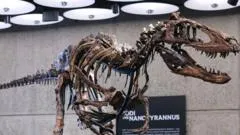
What makes the Nanotyrannus skeleton so valuable?
The specimen, nicknamed Jodi, is considered an "excellent exhibition-ready" skeleton by Sotheby's, featuring approximately 191 fossil-bone elements and a highly preserved, nearly complete skull. The auction price of $47.3m far exceeded the initial $9m estimate. This sale marks the first time a Nanotyrannus has reached the market since researchers confirmed the existence of the genus in October 2025.
The rarity of the find is significant, as Sotheby's noted that Jodi is one of only three such skeletons currently known to science. Its value is bolstered by its provenance and the recent scientific clarity surrounding its identity. The skeleton was discovered in the Hell Creek Formation in Montana by rancher Jodi Pierson and later excavated by commercial palaeontologist Clayton Phipps.
How does Nanotyrannus differ from Tyrannosaurus rex?
Nanotyrannus is a distinct genus that lived alongside Tyrannosaurus rex approximately 67 million years ago during the Late Cretaceous period. While long mistaken for juvenile T. rex specimens, recent research has proven they are separate biological entities. According to Megan Jacobs, a palaeontologist at the University of Portsmouth, the Nanotyrannus is notably smaller and more gracile than its larger relative.
Key physical distinctions include:
- Build: A more sleek and slender frame compared to the robust T. rex.
- Dentition: Blade-like teeth specifically adapted for slicing through meat.
- Size: A height of roughly 10 feet (3m), making it significantly smaller than an adult T. rex.
The classification of Nanotyrannus as a separate genus was supported by research from Lindsay Zanno and James Napoli, which utilized findings from the "Dueling Dinosaurs" fossil—a specimen found near Jodi that depicts a Nanotyrannus and a Triceratops in combat.
Why is the private sale of fossils controversial?
The sale of Jodi has triggered a divide in the scientific community regarding the ethics of private fossil ownership. Many researchers argue that high-value fossils should be housed in museums to ensure they remain accessible for study and public inspiration. Professor Steve Brusatte of the University of Edinburgh described the trend as "harrowing," suggesting that such specimens might disappear into private vaults, away from the eyes of students and families.
The debate centers on two primary concerns:
Scientific Accessibility
When fossils are sold to private collectors, they may become unavailable for peer-reviewed research. Scientists argue that public institutions provide the necessary environment for long-term preservation and academic scrutiny.
Public Education vs. Private Investment
Critics compare the loss of public access to the private ownership of the Mona Lisa. However, some experts, including Megan Jacobs, suggest that the high costs of excavation and the commercial nature of the industry are realities that eventually lead many specimens into the public eye regardless of their initial sale.
FAQ: Nanotyrannus skeleton auction
What is the record for the most expensive dinosaur fossil?
The record is held by a Tyrannosaurus rex named Gus, which sold at Sotheby's in July for $50.1m. Jodi, the Nanotyrannus, is currently the second-most valuable dinosaur fossil sold at auction.
Where was the Nanotyrannus skeleton discovered?
The skeleton was found in the Hell Creek Formation in the US state of Montana. It was discovered by rancher Jodi Pierson on her land and subsequently excavated by Clayton Phipps.
Key takeaways
- The Nanotyrannus skeleton nicknamed Jodi sold for $47.3m at a New York auction.
- Jodi is the second-most valuable dinosaur fossil ever sold, following the $50.1m sale of Gus.
- Nanotyrannus is a distinct, more slender genus from Tyrannosaurus rex.
- The sale has sparked debate over whether fossils belong in private collections or museums.
Conclusion
The $47.3m sale of the Nanotyrannus skeleton represents both a milestone for the fossil market and a flashpoint for palaeontological ethics. While the auction highlights the immense value and beauty of Late Cretaceous specimens, it also underscores the tension between private commercial interests and the scientific community's desire for public accessibility. As rare fossils like Jodi continue to command record-breaking prices, the industry must navigate the balance between rewarding the efforts of excavators and ensuring that the world's natural history remains a shared resource for education and research.