What are the immediate demands of the new Serbian MPs?
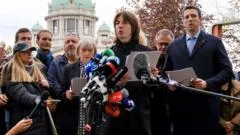
The newly elected representatives on the Student List are calling for the immediate dismissal of high-ranking officials within the country's security and judicial apparatus. Speaking from Pioneers' Park, the MPs specifically targeted the heads of the police, the BIA security agency, and the anti-terror unit, alleging that these officials oversaw or participated in illegal activities during the previous administration.
The movement's urgency is driven by a fear that the transition of power, which is expected to take several weeks, could provide a window for the destruction of evidence regarding past wrongdoings. This push for accountability is deeply rooted in the movement's origins, which began as protests following the November 2024 collapse of a railway station canopy in Novi Sad. That tragedy, which killed 16 people, became a catalyst for public outrage over alleged systemic corruption in infrastructure and governance.
The Student List has proposed a rigorous 'Student Plan' designed to address these grievances through several key pillars:
- Halting the ongoing plunder of state resources.
- Returning stolen assets to the national budget.
- Directing recovered funds into education and economic development.
Early signs of institutional change are already visible. At the state broadcaster RTS, director Manja Grčić has stepped down, a move seen as the first step in purging loyalists from state-controlled media. Additionally, the new MPs have signaled their intention to replace the head of Telekom Srbija, Vladimir Lučić.
How will the proposed lustration law reshape Serbian institutions?
The introduction of a lustration law is a central component of the reform agenda proposed by the new administration. Dejan Šoškić, an economist and newly elected MP who previously served as a central bank governor, has advocated for this measure to ensure that the transition is not merely cosmetic but structural.
Lustration, in this context, refers to the legal process of banning individuals from holding public office if they are found to have violated the rights of citizens or participated in the corrupt apparatus of the former Vučić government. This mechanism is intended to prevent the old political guard from maintaining influence through the shadow structures of the state.
The challenges of a complete institutional reset
Implementing such a sweeping purge presents significant logistical and political hurdles. Because the previous administration held control over nearly all major pillars of authority for an extended period, the institutional memory and personnel are deeply intertwined with the former ruling party.
Strahinja Subotić of the Belgrade-based European Policy Centre notes that while the mandate for change is clear, the administration will face the difficult task of navigating a landscape where power is heavily entrenched. He suggests that for the new government to succeed, it must eventually find ways to "build bridges to the segments that have been operating well in the past," balancing the need for a purge with the necessity of maintaining functional state services.
Who comprises the new political leadership in Serbia?
The incoming government is characterized by its lack of traditional political experience, consisting of a diverse group of 141 candidates selected through a meticulous and secretive process by students from across the country. This group is not a monolith of career politicians but a collection of intellectuals, professors, artists, athletes, and medical professionals, including 12 doctors and surgeons.
This diversity presents both an opportunity for fresh perspectives and a challenge for cohesive governance. Unlike traditional parties with a single charismatic leader, the Student List operates without an obvious central figure, relying instead on a collective commitment to their detailed manifesto.
Radomir Saičić, a professor of organic chemistry at the University of Belgrade and a prominent member of the list, has emphasized that while the practicalities of governing will be learned on the job, the legislative direction is already set. He noted that the MPs will adhere strictly to the 1,200-page plan developed by the student movement, maintaining a close consultative relationship with the students who initiated the change.
Will the election result alter Serbia's international standing?
While the student-led victory has been welcomed by the European Union, the movement's manifesto suggests that a radical shift in foreign policy may not be the immediate priority. The EU has pledged support for reforms regarding the rule of law, media freedom, and anti-corruption efforts, yet the Student List describes the bloc primarily as an "important economic partner" rather than a primary political goal.
For years, Serbia has maintained a complex balancing act, remaining a candidate for EU membership while sustaining close ties with Russia and China. This includes the decision not to impose sanctions on Moscow following the 2022 invasion of Ukraine, a stance that has historically been linked to preferential energy pricing from Russia.
The new leadership appears cautious about disrupting these delicate balances. Dejan Šoškić has expressed skepticism regarding the efficacy of sanctions, citing Serbia's historical experience in the 1990s. He argued that sanctions often disproportionately affect the general population without successfully altering state policy. Consequently, the new government is expected to focus heavily on domestic institutional reform before addressing the broader complexities of Serbia's position between Western and Eastern interests.
FAQ: Student-led election in Serbia
What caused the rise of the student movement in Serbia?
The movement gained momentum following a tragic accident in November 2024, when a railway station canopy collapsed in Novi Sad, killing 16 people. This event triggered widespread protests against systemic corruption and a demand for accountability in public infrastructure and governance.
What is the 'Student Plan' for Serbia?
The Student Plan is a 1,200-page document that outlines a roadmap for national rebuilding. It focuses on halting the theft of state assets, returning stolen goods to the budget, and prioritizing investments in the national economy and the education system.
Will the new government change Serbia's relationship with Russia?
There is currently no indication of a major shift in foreign policy. While the EU supports the new government, the student-led MPs have focused on economic partnership with the EU and have expressed reservations about the effectiveness of international sanctions.
What is lustration in the Serbian political context?
Lustration refers to a proposed law that would bar former members of the previous administration or party apparatus from holding public office if they are proven to have violated citizens' rights or engaged in corrupt practices.
Who are the leaders of the new Serbian government?
The government lacks a single prominent leader. Instead, it is composed of 141 diverse individuals, including professors, doctors, and artists, who were selected by students to implement the movement's specific policy agenda.
Key takeaways
- The Student List won the election, successfully ousting Aleksandar Vučić's party from power.
- New MPs are demanding the resignation of top police, intelligence, and judicial officials.
- A proposed lustration law aims to ban corrupt former officials from public office.
- The movement's core agenda is driven by a detailed 1,200-page student manifesto.
- Foreign policy is expected to remain cautious regarding EU and Russian relations.
Conclusion
The victory of the student-led movement represents a profound attempt to reset Serbia's political and institutional landscape. By prioritizing domestic accountability and the rule of law through measures like lustration, the new administration seeks to address the corruption that has long plagued the state. However, the transition from a protest movement to a functioning government will be fraught with difficulty, as these novice politicians must navigate entrenched interests and complex international dynamics. The success of this "spring cleaning" will ultimately depend on their ability to implement their detailed plan while maintaining stability in a deeply divided political environment.