What caused the Toledo train disaster?
Initial findings suggest that a series of catastrophic human errors led to the high-speed collision in central Spain. While a formal investigation is ongoing, Transport Minister Oscar Puente has already moved to frame the incident as a failure of operational procedure rather than a systemic infrastructure deficit. According to Minister Puente, the accident occurred during a transition to manual control following a system failure.
The technical specifics of the crash involve the interaction between human controllers and the rail signalling environment. The minister confirmed that during the incident, a controller issued instructions to a stalled train to restart and proceed at speeds of up to 160km/h (100 mph), despite the presence of another train stuck on the tracks ahead. This error was visible to staff in the Madrid control centre via audio communications and monitoring screens, yet the advancing train was never issued an emergency stop order.
The role of the LZB signalling system
A central point of contention in the aftermath of the disaster is the reliability of the LZB signalling system used on the Spanish high-speed network. Minister Puente defended the technology, noting that it is also employed in Germany and Austria. He revealed that while the system has experienced 170 failures in Spain so far this year, these instances are considered "normal" and align with European Union averages. However, the recurring nature of these failures creates a dangerous window of vulnerability when the network must revert to manual management.
How is the Spanish government responding to the crisis?
The Socialist-led government is attempting to control the narrative by emphasizing individual accountability over institutional negligence. Transport Minister Oscar Puente has resisted calls for his resignation, characterizing his role not as one of departure, but as one of "duty" to remain and investigate the technical failures. He has positioned himself as a figure who will "elucidate" the facts and work toward restoring public confidence in rail travel.
This defensive stance has drawn sharp criticism from the opposition. The People's Party (PP) has demanded Puente's resignation, labeling the move a "moral" and "ethical" necessity following the loss of life. The government's strategy appears to be focused on distancing the cabinet from the immediate cause of the crash by highlighting the specific errors made by rail controllers. By focusing on "human error," the administration seeks to prevent the disaster from being viewed as a symptom of chronic underinvestment in national infrastructure.
Why does this disaster threaten Pedro Sánchez's re-election?
The timing of the Toledo crash is politically devastating for Prime Minister Pedro Sánchez, occurring only weeks before the snap general election he initiated. The disaster has transformed the electoral atmosphere from a debate over policy to a referendum on government competence. For the Sánchez administration, the rail tragedy is the latest in a series of crises that have eroded public trust, including corruption allegations involving relatives and recent migration challenges in the Ceuta exclave.
Political analysts suggest that the disaster has effectively handed the momentum to the center-right opposition. According to Professor Pablo Simon of Madrid's Carlos III University, the government has lost control of both the campaign agenda and the emotional tone of the election. The prevailing sentiment among the electorate is shifting toward a perception of national decay, making it increasingly difficult for the Socialists to attract the undecided or apathetic voters they previously relied upon to bolster their numbers.
Shifting electoral simulations
Current political modelling indicates a significant decline in the Socialist party's viability. Professor Simon noted that in approximately 95% of recent electoral simulations, the People's Party (PP) holds a majority, potentially forming a coalition with the far-right Vox party. The sudden shift in public mood, driven by the fear and anger following the crash, has moved the needle toward the right-wing opposition faster than many analysts had anticipated.
What is the impact on public confidence and social stability?
Beyond the immediate political fallout, the disaster has triggered a profound loss of trust in Spanish institutions. Paco Camas, a pollster at Ipsos, observed that the frequency of these accidents—with two major fatal crashes occurring in less than a year—is destroying confidence not just in the railways, but in the government's ability to manage the country. This institutional distrust is manifesting in both voter behavior and civil unrest.
The social atmosphere in Spain is currently characterized by high tension and volatility. Small-scale protests led by far-right groups have already emerged in Madrid, and authorities remain on high alert for potential clashes as further demonstrations are organized online. In regions like Toledo, the mood is described as one of nervousness and anger, with citizens expressing a readiness to shift their political allegiances entirely due to the perceived failure of the state to ensure basic safety.
Frequently asked questions
How many people died in the Toledo train disaster?
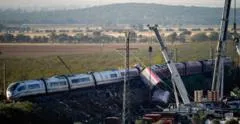
According to current reports, 69 bodies have been recovered from the wreckage in central Spain. The disaster involved a high-speed collision that left debris spread across the tracks and down an embankment, resulting in a significant loss of life that has shocked the nation.
Was the rail signalling system at fault?
The government maintains that the LZB signalling system is adequate and used elsewhere in Europe. However, the system has failed 170 times in Spain this year. The primary issue identified is the dangerous period when the system fails and control shifts to manual operations.
What is the political situation in Spain following the crash?
The disaster has severely weakened Prime Minister Pedro Sánchez's position ahead of a snap election. Polls suggest the opposition People's Party is now leading in most simulations, as the crash has shifted the national mood toward a sense of institutional decay and incompetence.
How does this compare to the previous train accident?
This is the second major rail disaster in nine months. The previous accident occurred near Cordoba in January, killing 46 people. While the Cordoba crash was reportedly linked to rail cracks, the Toledo disaster is being attributed to human error during manual control.
Will the Transport Minister resign?
Despite calls for resignation from the People's Party, Minister Oscar Puente has refused to step down. He argues that his duty is to remain in office to investigate the causes of the accident and implement improvements to the rail safety protocols.
Key takeaways
- The Toledo train disaster resulted in at least 69 fatalities in central Spain.
- Transport Minister Oscar Puente attributed the crash to human error during manual rail control.
- The LZB signalling system has recorded 170 failures in Spain during the current year.
- Political analysts predict the crash has significantly improved the People's Party's election prospects.
- The disaster follows a previous fatal collision near Cordoba that killed 46 people.
Conclusion
The Toledo train disaster represents more than a tragic loss of life; it is a pivotal moment for the Spanish state. By exposing vulnerabilities in the transition to manual rail control and highlighting the human errors that can occur during such shifts, the accident has undermined the government's narrative of technical competence. As the formal investigation proceeds, the political consequences are already manifest. With the electorate's confidence in both the rail network and the Sánchez administration in decline, the upcoming snap election is likely to be defined by a demand for stability and accountability over the existing leadership.