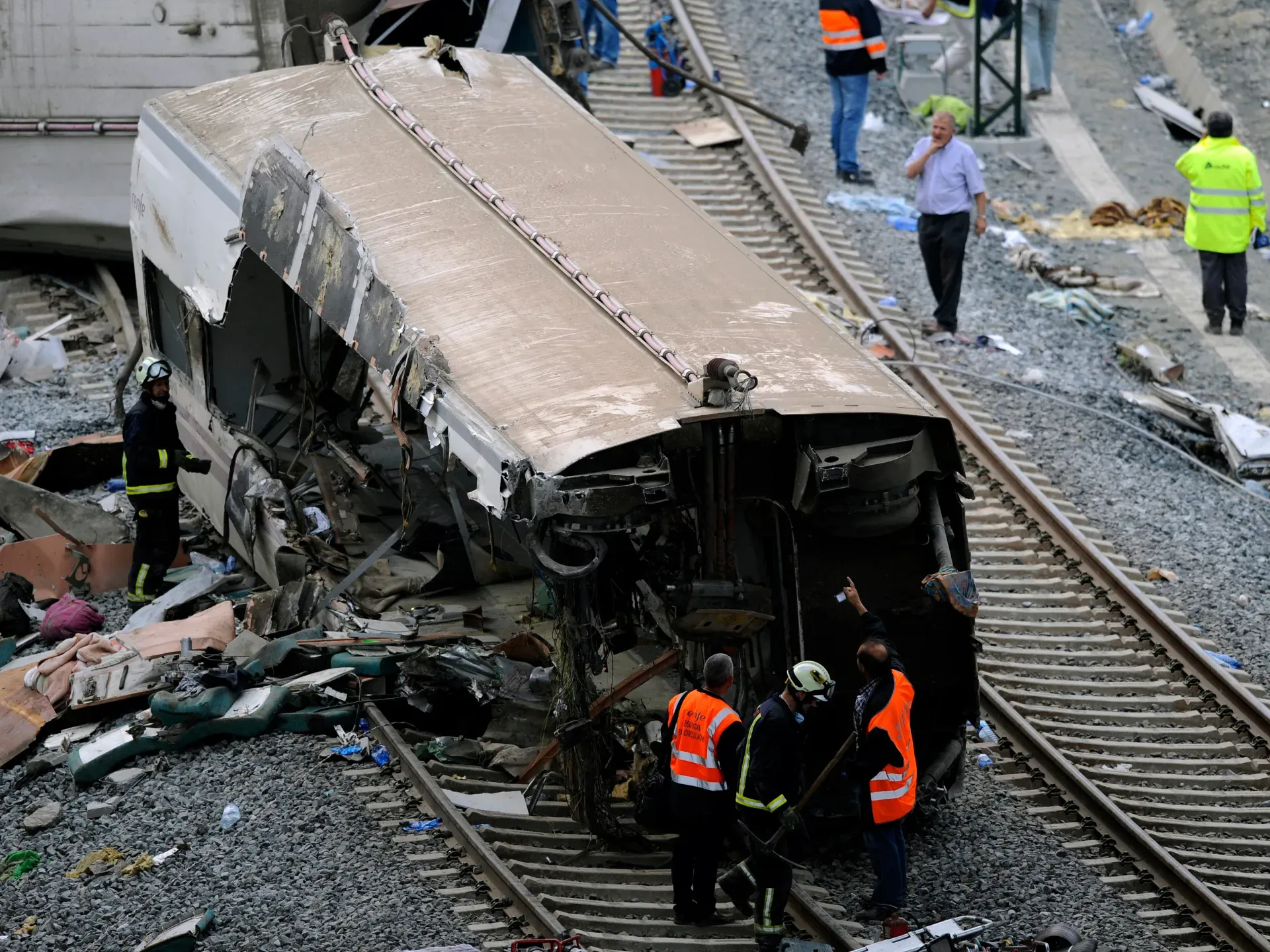
What are the details of the recent Spain train crashes?
The most recent disaster occurred near Urda, a town close to Toledo in central Spain, where a collision involving two trains resulted in at least 69 fatalities on Wednesday, October 29, 2026. This tragedy follows a pattern of recent high-profile accidents on the Spanish rail network. Only ten months prior, in January 2026, a collision in Adamuz, near Cordoba, killed 46 people. The Adamuz investigation determined that a broken rail caused one train to veer off its path and into the path of an oncoming train.
The Urda accident is being investigated for potential human error and failures within the control system. These recent events follow the historical benchmark of the Angrois disaster near Santiago de Compostela in July 2013, which remains Spain’s deadliest rail crash with 80 fatalities. In that instance, a high-speed train traveling at 200km/h (125mph) derailed on a bend where it should have been moving at 80km/h (50mph).
A timeline of recent major Spanish rail disasters
- July 2013 (Angrois): 80 deaths due to excessive speed on a bend.
- January 2026 (Adamuz): 46 deaths caused by a broken rail.
- October 2026 (Urda): At least 69 deaths, involving potential control system failure and human error.
How have survivors been impacted by these tragedies?
Survivors of these accidents continue to suffer from profound psychological trauma and post-traumatic stress disorder (PTSD) years after the events. Cristobal Gonzalez, a 64-year-old retired army captain who survived the 2013 Angrois crash, describes the lasting mental scars that make it difficult to share his experiences. He recalls the terror of the front carriage flying off the tracks and his subsequent efforts to assist others amidst the wreckage.
Santiago Rosendo, a passenger in the January 2026 Adamuz collision, described the suddenness and violence of the impact. He recounted a sudden stop followed by a loud crash that left the train sliding on its side in total darkness. Rosendo expressed disbelief that such an accident could repeat on the same line so shortly after the previous disaster. These personal accounts highlight the human cost that extends far beyond the immediate physical casualties of the crashes.
Why is there a call for increased maintenance investment?
Experts argue that the frequency of recent accidents is a direct consequence of insufficient spending on rail maintenance relative to infrastructure expansion. Between 2018 and 2022, Spain averaged approximately $1.67bn annually on high-speed lines. However, European Commission data indicates that only 16 percent of this budget was allocated to maintenance or repairs, with the vast majority dedicated to building new infrastructure.
This spending ratio contrasts sharply with other European nations that manage smaller high-speed networks. According to the data, Italy, Germany, and France allocate between 33 and 39 percent of their budgets to maintenance. Jose Maria Goicolea, spokesperson for the Spanish Association of Civil Engineers, emphasized that as the network grows and usage increases, the focus must shift from building new lines to maintaining existing ones. This sentiment is echoed by infrastructure expert Ramiro Aupin Lopera, who noted a "ridiculous" decline in maintenance investment in Spain since the 2011 financial crisis.
What role did the LZB control system play in the accidents?
The Madrid-Seville line, which was the site of both the Adamuz and Urda crashes this year, relies on an aging German-made LZB control system dating from the 1970s. This system is currently in the process of being phased out, but its continued use has become a point of significant contention. While the Urda crash may have involved human error, the failure of the LZB system was identified as a contributing factor.
Criticism of the aging technology
Private rail operators have been vocal about the risks posed by this obsolete technology. Helen Venezuela, former director of Ouigo Espana, compared the experience of using the current system to "watching Netflix in black and white" while the industry has moved far beyond it. The mismatch between modern high-speed rail requirements and 1970s-era control technology is seen by many as a critical vulnerability in the Spanish network.
How has rail usage changed in Spain?
The demand for high-speed rail in Spain has grown significantly, placing more strain on the existing infrastructure. In 2024, approximately 40 million people used the high-speed network, nearly doubling the ridership recorded in 2019. This surge in volume means that any technical or maintenance failure has a much higher potential for mass casualty events than in previous decades.
Despite the long-term growth, there were fluctuations in the most recent data. In the first half of 2026, approximately 25 million passengers traveled on the high-speed network, representing a 14 percent year-on-year decrease. Nevertheless, the increased density of traffic on lines using older systems like the LZB remains a primary concern for safety advocates and rail unions alike.
FAQ: Spain train crashes
What caused the Adamuz train crash in January 2026?
The investigation into the Adamuz accident near Cordoba concluded that a broken rail was the primary cause. This mechanical failure caused one of the trains to veer off the track and into the path of an oncoming train, leading to the collision and 46 deaths.
Is the LZB control system still in use in Spain?
Yes, the German-made LZB system is still in use on the Madrid-Seville line, though it is currently being phased out. Critics and private operators have expressed concern that this 1970s-era technology is obsolete and contributes to safety risks on high-speed routes.
How does Spanish maintenance spending compare to Europe?
Spain spends significantly less on maintenance than its neighbors. While Spain allocates only 16 percent of its high-speed rail budget to maintenance, countries like Italy, Germany, and France allocate between 33 and 39 percent of their respective budgets to these essential repairs.
What was the deadliest rail crash in Spain?
The deadliest rail disaster in Spanish history occurred in July 2013 near Santiago de Compostela (Angrois). The accident resulted in 80 deaths when a high-speed train derailed while traveling at 200km/h on a bend where the speed limit was 80km/h.
Who are the main operators of high-speed rail in Spain?
The Spanish high-speed rail market includes the state-run operator Renfe, as well as two private companies: the French-owned Ouigo and the Italian-consortium-backed Iryo. All operators have voiced concerns regarding the safety of the aging LZB control systems.
Key takeaways
- Recent Spanish rail disasters in Urda and Adamuz have caused over 115 combined fatalities in 2026.
- Only 16 percent of Spain's high-speed rail budget is dedicated to maintenance, compared to up to 39 percent in France and Germany.
- The Madrid-Seville line continues to use the obsolete 1970s-era LZB control system.
- High-speed rail ridership in Spain nearly doubled between 2019 and 2024, increasing network pressure.
Looking ahead at rail safety in Spain
The recent string of fatalities has moved the conversation from individual accidents to a broader critique of national infrastructure policy. The tension between expanding the high-speed network and maintaining its existing components has reached a breaking point. As survivors demand accountability and experts call for a pivot toward maintenance-heavy budgeting, the Spanish government faces increasing pressure to modernize control systems and address the technical vulnerabilities of its most heavily used lines. The coming months of investigations will likely determine if structural changes are implemented to prevent further loss of life.