Why has the Polish government deployed riot police at the Constitutional Court?
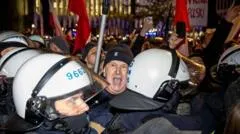
Riot police were deployed at the Constitutional Court in Warsaw to prevent demonstrators from entering the building during an intensifying confrontation between the state and the judiciary. The deployment follows a move by Justice Minister Waldemar Żurek to request the removal of legal immunity for Court President Bogdan Święczkowski and Vice-President Bartłomiej Sochański. The government intends to bring criminal charges against these officials, alleging they have obstructed the judicial process by preventing newly elected judges from adjudicating.
The tension on the ground reflects a deep-seated institutional deadlock. While the government views its actions as a necessary step to restore the rule of law, the Constitutional Court has issued a sharp rebuke via social media. The court characterized the government's actions as a "coup d'etat," asserting that the two targeted judges remain the legally appointed senior justices of the institution.
The immediate catalyst for police intervention
The immediate trigger for the police presence was the intersection of political protests and executive legal maneuvers. As Justice Minister Żurek moved to strip immunity, PiS supporters gathered outside the court premises to protest the government's intervention. The presence of armed police serves as a physical barrier between the opposing political factions, attempting to maintain order in a situation where legal interpretations are being contested in the streets as much as in the courts.
How did the dispute between Tusk and PiS originate?
The current crisis is the culmination of a judicial transformation initiated by the Law and Justice (PiS) party after they took office in 2015. During their tenure, the PiS-led government moved to secure a majority within the Constitutional Court, a body with the critical power to determine the legality of national legislation. This strategy aimed to ensure that the court's rulings aligned with the governing party's legislative agenda.
However, this restructuring faced significant international opposition. The European Court of Human Rights and the Court of Justice of the European Union both issued rulings stating that the PiS majority had improperly elected three judges. These courts found that the appointments duplicated positions that had already been validly filled by the previous parliament. Consequently, the European judicial bodies ruled that Poland's Constitutional Court no longer functioned as an "independent and impartial tribunal."
Prime Minister Donald Tusk has used these international rulings as a legal foundation to halt the publication of certain tribunal rulings. His administration argues that the court's current composition is a product of "lawlessness," a claim Tusk has defended by stating that restoring the rule of law is a difficult but essential duty that requires decisive, even painful, action.
What role does President Karol Nawrocki play in the confrontation?
President Karol Nawrocki, a figure backed by the PiS party, has become a central actor in the physical stand-off. In a dramatic turn of events, Nawrocki cancelled a mid-air trip to the Summer Youth Olympic Games in Dakar, Senegal, to attend the confrontation in Warsaw. According to his chief of staff, the President has now entered the Constitutional Court premises.
Nawrocki's involvement is part of a broader pattern of resistance to the Tusk government's judicial reforms. He has previously used his presidential veto to block attempts by the current administration to undo PiS-era changes. Furthermore, Nawrocki has refused to swear in five judges elected by parliament since March, citing alleged flaws in their selection procedures. This refusal has drawn criticism from international bodies, including the Venice Commission, which advised that the President should swear in these judges to ensure the court can function.
The impact of presidential vetoes on reform
The ability of the presidency to block judicial reform has created a legislative stalemate. By utilizing veto powers, both President Nawrocki and his predecessor, Andrzej Duda, have effectively neutralized several of Tusk's attempts to restructure the judiciary. This has left the government in a position where it must resort to more aggressive executive actions, such as the pursuit of criminal charges against sitting judges, to achieve its stated goals of depoliticization.
What are the legal and political criticisms of the government's actions?
The government's strategy has faced intense criticism from legal experts and political opponents, who argue that the methods being used may undermine the very rule of law they seek to protect. One prominent critic, Professor Marcin Matczak, has argued that the suspension of judges lacks any legal basis and could have long-term negative consequences for Polish democracy.
Matczak expressed concern that the sight of armed police and the use of ministerial decrees to remove court presidents could create a "powerful, anti-rule of law backlash" that lasts for decades. He suggested that the current actions might effectively "bury" the issue of judicial independence in Poland for the foreseeable future. These criticisms suggest that while the Tusk administration aims to correct past wrongs, its current tactics are being viewed by some as a different form of institutional overreach.
Political motivations are also being scrutinized. With parliamentary elections scheduled for next year, some observers suggest that Tusk's decisive actions may be an attempt to bolster his popularity among voters who demand a swift end to the PiS era. Conversely, supporters of the previous administration view these moves as an illegal attempt to consolidate power and bypass the established constitutional order.
Frequently asked questions
Why is the Constitutional Court considered so important in Poland?
The Constitutional Court holds the power to decide on the legality of legislation passed by the parliament. This means its rulings can invalidate laws, making it a central pillar in the balance of power between the government and the legal framework of the state.
Who are the judges currently at the center of the dispute?
The primary figures are Court President Bogdan Święczkowski and Vice-President Bartłomiej Sochański. The Tusk government seeks to strip them of their immunity to bring criminal charges, while the court maintains they are the only legally appointed senior justices.
What did the European courts say about the Polish judiciary?
The European Court of Human Rights and the Court of Justice of the EU ruled that the PiS-era appointments were improper. They concluded that the court was no longer an independent or impartial tribunal due to the duplication of existing judicial positions.
How has President Nawrocki responded to the crisis?
President Nawrocki has actively participated in the confrontation, even cancelling an international trip to attend the events in Warsaw. He has also refused to swear in several new judges, citing concerns over their selection process.
What is the Venice Commission's stance on this matter?
The Venice Commission, an advisory body of the Council of Europe, has recommended that President Nawrocki should swear in the newly elected judges. This action is intended to allow them to sit on the bench and ensure the court remains functional.
Key takeaways
- Riot police were deployed in Warsaw to manage a stand-off at the Constitutional Court.
- The Tusk government seeks to prosecute two senior judges by stripping their immunity.
- The Constitutional Court has labeled the government's actions a "coup d'etat."
- International courts have previously ruled the court lacked independence due to improper appointments.
- President Nawrocki has blocked several judicial reforms through vetoes and refusal to swear in judges.
Synthesis of the judicial crisis
The standoff at Poland's Constitutional Court represents a critical juncture for the nation's democratic institutions. What began as a dispute over the legitimacy of judicial appointments under the Law and Justice party has evolved into a direct confrontation involving the executive, the presidency, and the judiciary. While the Tusk administration maintains that its actions are a necessary correction to years of judicial lawlessness, the use of criminal charges and police intervention has raised significant concerns regarding the stability of the rule of law. As Poland approaches parliamentary elections, the resolution of this crisis will likely define the country's political and legal landscape for years to come.