What is the significance of the 108 stupas built in Gelephu?
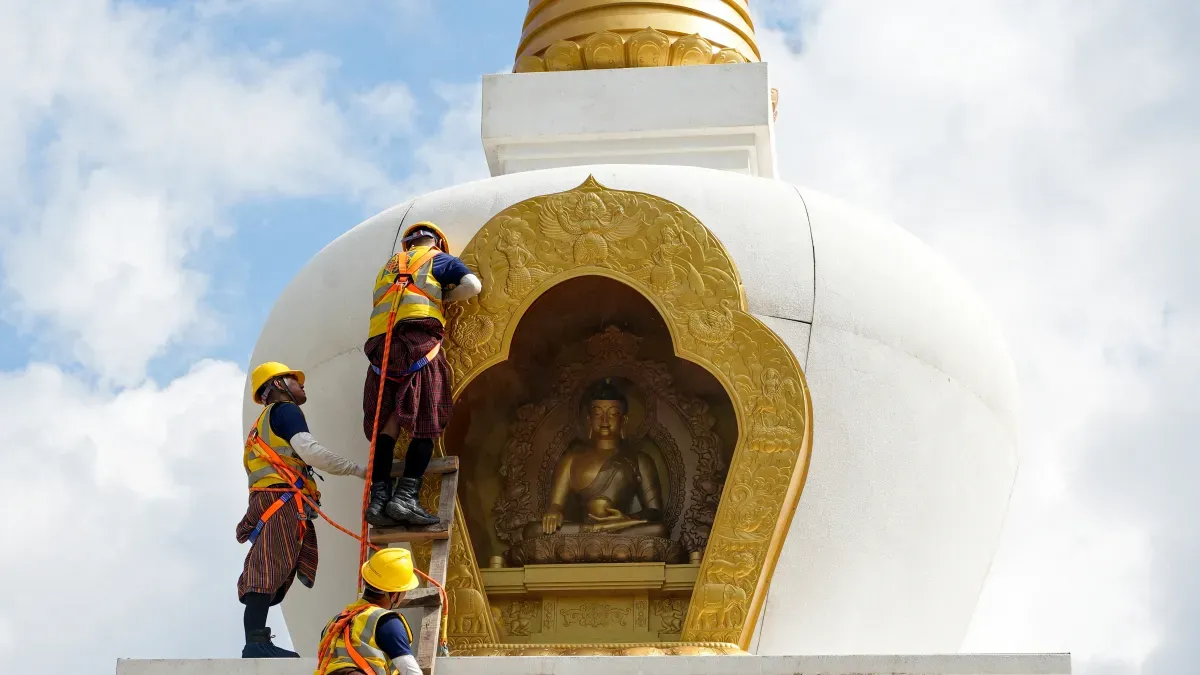
The construction of 108 Buddhist stupas along a 12km riverbank near the Indian border serves as both a spiritual milestone and a physical manifestation of national unity. These 15-metre-tall monuments, known as sacred Buddhist structures, were erected by more than 40,000 volunteers in a single day on November 1, 2026. The number 108 holds deep religious importance in Buddhism, which is the primary faith practiced throughout the Himalayan kingdom.
According to officials, the volunteers began their work after midnight to complete the task. The structures are intended to represent a permanent form of prayer, crafted from stone and earth. This massive undertaking was not merely a construction project but a ceremonial event that drew nearly 200,000 attendees—roughly 25% of Bhutan's total population. During the ceremony, King Jigme Khesar Namgyel Wangchuck expressed his gratitude to the participants, noting his initial concerns regarding the feasibility of completing 108 stupas within a 24-hour window.
The symbolism of the number 108
In the Buddhist tradition, the number 108 is considered sacred and is frequently utilized in rituals, prayer beads, and architectural alignments. By choosing this specific number for the Gelephu Mindfulness City's inaugural monument project, the Bhutanese leadership is attempting to weave the kingdom's spiritual identity into the very fabric of its modern economic development. This alignment is central to the nation's unique philosophy of balancing material progress with spiritual well-being.
Why is Bhutan developing the Gelephu Mindfulness City?
Bhutan is launching the Gelephu Mindfulness City to address critical socio-economic challenges, including rising unemployment, declining birth rates, and the significant migration of skilled workers. The project, conceived by the King and designed by Danish architects, seeks to create a vibrant economic hub that provides opportunities for the younger generation, encouraging them to remain within the country rather than seeking livelihoods abroad.
The vision for the city is multifaceted, targeting several high-growth sectors. The government aims to attract international investment in the following areas:
- Sustainable business and green technology
- Advanced education and research
- Tourism and cultural heritage
- Financial services and digital infrastructure
By establishing a special economic zone via royal charter in 2024, the monarchy intends to leverage the country's unique identity to build a modern, sustainable urban center. While the current site is a small town of approximately 10,000 residents located in southern Bhutan, the long-term goal is to transform it into a major regional gateway. This development is situated roughly 240km south of the capital, Thimphu, and sits strategically along the border with India.
How will the city connect to regional and global markets?
Strategic connectivity is a cornerstone of the Gelephu Mindfulness City plan, focusing on integrating Bhutan into the broader South Asian economic landscape. The project is designed to utilize its proximity to India to facilitate trade and movement. A key component of this infrastructure plan involves connecting the site to India’s rail network in the neighbouring state of Assam.
Furthermore, the development includes significant transportation upgrades to support international interest. An international airport is currently slated to open by 2029, which will provide the necessary access for global tourists and business investors. This connectivity is intended to transform the landlocked Himalayan nation from a remote kingdom into a reachable hub for sustainable commerce. The integration of physical infrastructure with digital and financial services is intended to create a seamless environment for the targeted industries.
What role do cryptocurrency and technology play in this vision?
The Gelephu Mindfulness City is deeply linked to Bhutan's growing ambitions in the digital asset space, specifically through cryptocurrency mining. The kingdom has been utilizing its surplus hydropower—a renewable resource abundant in the Himalayas—to mine Bitcoin. This strategy seeks to convert natural energy resources into digital wealth that can fund national development.
Government officials have pledged to use these digital assets to support the ongoing development of the new city. This intersection of traditional hydropower and cutting-edge blockchain technology represents a bold attempt to leapfrog traditional industrial stages of development. While some analysts have expressed skepticism regarding whether Bhutan can attract the massive levels of investment required to realize such an ambitious vision, the involvement of major international players provides some momentum.
Private sector involvement and investment concerns
The scale of the project has led to questions from market analysts regarding the actual capacity of a small nation like Bhutan to sustain such massive capital requirements. However, the project has already secured notable high-profile support. For instance, Indian billionaire Gautam Adani, whose conglomerate spans sectors from ports to power, joined the project as a founding member in January. This level of private sector engagement suggests a growing confidence in the project's long-term viability, despite the inherent risks of such a large-scale urban experiment.
How does this project align with Gross National Happiness?
The development of Gelephu is an attempt to modernize Bhutan's famous "Gross National Happiness" (GNH) policy, ensuring that economic growth does not come at the expense of cultural and spiritual values. Instead of choosing between wealth and well-being, the government is attempting to use the city as a vehicle to achieve both simultaneously.
By focusing on "mindfulness" as a core component of the city's brand, Bhutan is positioning itself as a unique destination for a specific type of global investor and resident—those interested in sustainable, ethical, and spiritually conscious living. This approach aims to create a "vibrant economic hub" that remains authentically Bhutanese. For local residents and organizations, such as the Organisation for Youth Empowerment, the project represents a historic opportunity to provide meaningful work and a future for the nation's youth within their own borders.
Frequently asked questions
What is the main goal of the Gelephu Mindfulness City?
The primary goal is to drive economic growth in Bhutan and provide sustainable career opportunities for young people. By attracting investment in green technology, tourism, and financial services, the government hopes to reduce the mass migration of skilled workers and address rising unemployment rates.
How many people participated in the stupa building event?
More than 40,000 volunteers participated in the construction of the 108 stupas. This massive community effort was part of a ceremony attended by approximately 200,000 people, which represents nearly one-quarter of Bhutan's total population.
Is Bhutan using cryptocurrency to fund this project?
Yes, the project is linked to Bhutan's cryptocurrency ambitions. The kingdom uses its surplus hydropower to mine Bitcoin, and the government has pledged to use these digital assets to support the development and infrastructure of the Gelephu Mindfulness City.
When will the new international airport be ready?
The development plan for the Gelephu Mindfulness City includes the construction of an international airport. According to the current project timeline, this airport is slated to open in 2029 to facilitate international travel and investment.
Who is involved in the funding and design of the city?
The city was conceived by King Jigme Khesar Namgyel Wangchuck and designed by Danish architects. Additionally, Indian billionaire Gautam Adani joined the project as a founding member in January 2026 to support its realization.
Key takeaways
- Over 40,000 volunteers built 108 sacred Buddhist stupas in a single day.
- The Gelephu Mindfulness City aims to combat youth migration and unemployment.
- Bhutan intends to use Bitcoin mining from surplus hydropower to fund development.
- An international airport is scheduled to begin operations in 2029.
- The project targets green technology, education, and sustainable financial services.
Conclusion
The Gelephu Mindfulness City represents a high-stakes attempt by Bhutan to redefine its economic future without sacrificing its cultural soul. By blending ancient Buddhist traditions—symbolized by the 108 stupas—with futuristic technologies like cryptocurrency and green energy, the kingdom is carving out a unique niche in the global economy. While the scale of the ambition is unprecedented for a nation of 800,000 people, the strategic focus on connectivity and sustainable investment provides a roadmap for navigating the modern challenges of migration and economic stability.